Zane Hammoud, M.D., a thoracic surgeon based in Detroit, recalls a recent late-stage lung cancer patient of his. The patient had received neoadjuvant therapy to shrink their cancer cells before minimally invasive surgery, and left the hospital five days later to make a full recovery within six weeks.
“Twenty years ago, I would have had to give this patient a thoracotomy,” a time-consuming procedure that would require breaking open the ribs to access the lungs,1 Dr. Hammoud explains.
Thanks to novel innovations that have entered the market to treat these types of cases, Dr. Hammoud was able to help that patient make a full recovery.
Indeed, the healthcare industry has come a long way in lung cancer care. For example, through the development of the first bispecific antibody in lung cancer, Johnson & Johnson aims to bring renewed hope in EGFR-mutated non-small cell lung cancer where less than 20% of patients are alive after five years, and between 25% and 40% never get the chance to receive a subsequent therapy after first-line treatment. The company’s rapidly expanding development program in lung cancer includes both monotherapy and combination strategies, with the potential to build standard-of-care treatment regimens.
And yet the disease continues to be the most common cancer in the world and the leading cause of cancer deaths.2 In 2022, roughly 2.5 million people were diagnosed with lung cancer, and over 1.8 million died from the disease.2 While tobacco use—the leading cause of lung cancer3—has declined dramatically over the past few decades, lung cancer incidence and mortality rates continue to rise.4
Why? According to Carmen Di Palma, Head of Thoracic Surgery and Lung Cancer, Europe, Middle East and Africa (EMEA), Johnson & Johnson MedTech, this is because the vast majority of lung cancer patients are diagnosed at an advanced stage, when mortality rates climb as high as 90%.5
Conversely, if lung cancer is detected early enough, the majority of patients will live.5 But early lung cancer can often be asymptomatic, and there aren’t widespread routine lung cancer screenings.6 As a result, only about 30% of lung cancer cases are discovered in that crucial early phase.7
What's more, lung cancer patients often leave their appointments with more questions than answers. A recent multi-country survey found that many lung cancer patients are not properly informed about the range of life-saving treatment options available to them, with some unaware that surgery was even a possibility. According to the survey results, patients often struggle to understand complex medical terms shared by their healthcare teams, which can leave them confused and worried about their health.8
“The biggest lesson we learned is that there’s a major discrepancy regarding the emotional and also tangible expectations between patients and surgeons,” says Di Palma. These gaps can delay diagnosis, postpone treatment and ultimately lead to poorer outcomes. To wit: A study recently published in JMIR Public Health and Surveillance expects that, by 2035, lung cancer will be “a major challenge to public health worldwide.”9
Simply put: The need to continue innovation and education is critical. Building on decades of work, Johnson & Johnson continues to prioritize efforts that may help accelerate early detection, advance treatment options, improve surgical outcomes, and teach healthcare professionals (HCPs) about the latest tools and techniques—all to catch cancer earlier and improve care from diagnosis through life-saving treatment.
“No patient wants a ‘wait and see’ approach”
Late diagnosis is the leading driver of lung cancer’s high mortality rate: "It's critical to find malignant lesions lurking in the lungs as soon as possible to initiate treatment before they grow and metastasize," Dr. Hammoud says.
Up until five years ago, that was typically achieved by guiding a scope down the throat and into the lungs to search for suspicious nodules. These manual scopes can struggle to reach and biopsy tiny nodules located in the outermost regions of the lungs—where nearly half of early-stage nodules are typically found. “We call them ground-glass nodules because they are that small,” says Aleksandra Popovic, Ph.D., President of MONARCH™ Platform, Johnson & Johnson MedTech.
As a result, many lung cancer patients who undergo manual bronchoscopy have had to follow a “wait and see approach” in which doctors monitor suspicious lesions over the course of several months to see if they develop into cancer. “No patient wants that,” says Popovic.
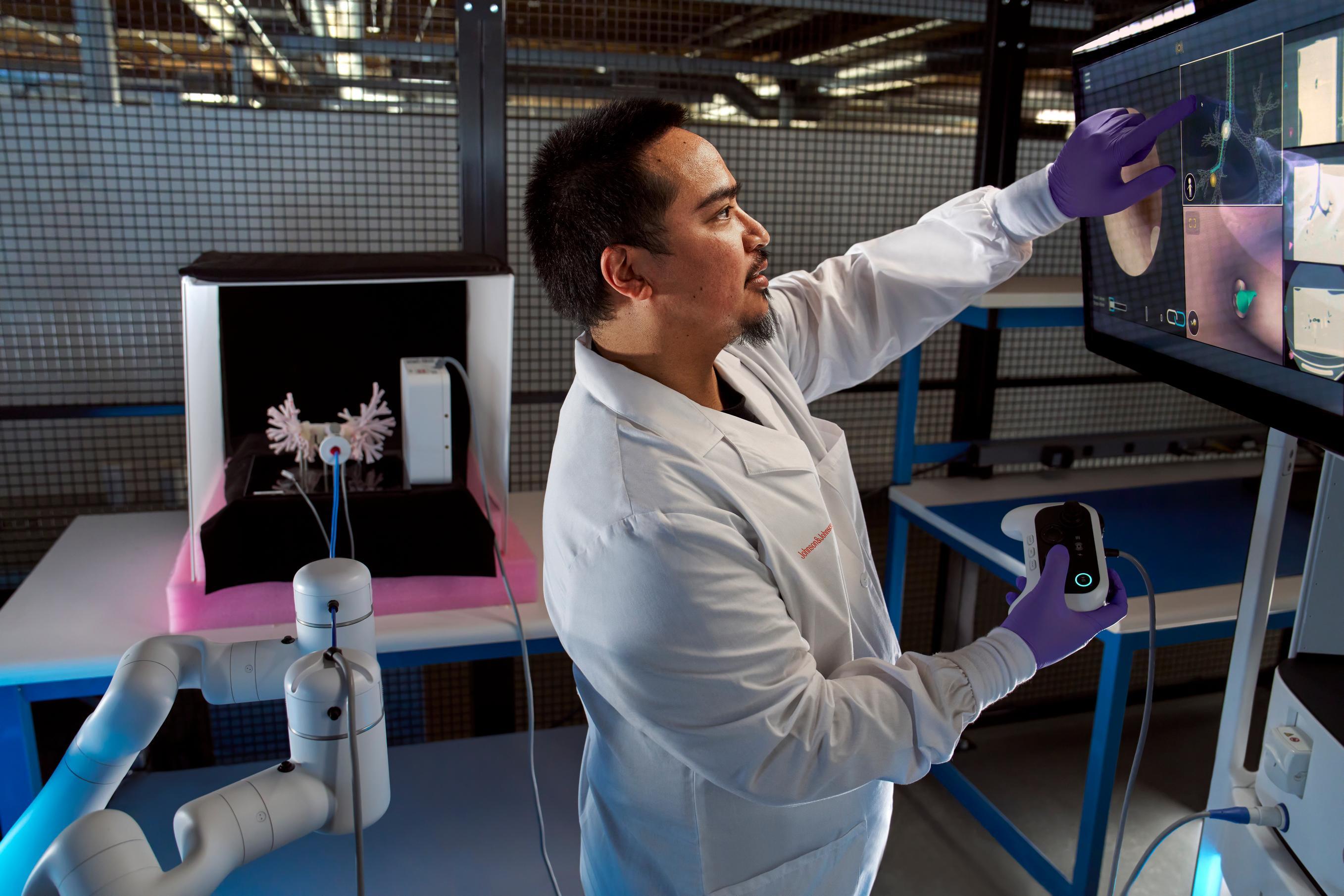
In 2019, Johnson & Johnson MedTech brought to market MONARCH™ Platform, a robotically assisted bronchoscopy (RAB) system. “Today it is a robotically-guided scope with AI-enabled real-time guidance, enabling interventional pulmonologists to navigate the complex pathways of the lung with a high degree of accuracy during biopsy procedures,” Popovic says.
Manual bronchoscopy can be physically demanding and highly dependent on individual skill. The MONARCH Platform changes that, by offering clinicians a comfortable handheld controller*8 and advanced computer vision for real-time navigation.9 This technology enables far deeper access into the lungs, facilitating biopsy on small peripheral nodules†10 critical for early detection.
“The goal is to really be able to impact the entire spectrum of the disease,” explains Africa Wallace, M.D., Global Vice President of Medical Affairs, MedTech, Johnson & Johnson. “The push for early screening and novel technologies can help address lung cancer survival rates on a global level.”

The importance of staplers that can navigate a complex organ with precision
The lungs are a very tricky organ, notes Dr. Hammoud. He likens them to a sponge—there’s solid tissue filled with holes of air that vary in size, depending on the amount of tissue damage in the lungs. The lungs are also confined within the ribcage, “a rigid cavity that limits what you can do within the space,” he says.
Not to mention, when surgeons are removing damaged tissue, they need to immediately seal the lung back up—a complex task that necessitates the use of surgical staplers. A weak seal can have devastating consequences, including life-threatening bleeding and infections such as bronchopleural fistulas.11
When you’re transecting a pulmonary arterial vessel—one of the most commonly affected vessels in people with advanced lung cancer12—you need to change the angle of the stapler to move across the lung and effectively work in those tight spaces, Dr. Hammoud explains. “The stapler’s flexibility becomes very important in terms of articulation and angulation,” he says.
Johnson & Johnson’s ETHICON™ 4000 Stapler System offers greater articulation span and wider jaw aperture to help provide improved access for challenging anatomy.‡13,14 The stapler provides exceptional staple line integrity across the broadest range of tissue thickness.§15,16 It is also particularly powerful, Dr. Hammoud says, which may reduce the amount of effort needed to clamp down on the lung. Also important, according to Dr. Hammoud: the durability of the staples, which provide a tight seal.
Preventing complications with biosurgery and energy devices
While minor bleeding can obstruct the surgeon’s view in an operation, catastrophic bleeding can threaten the life of a patient. The introduction of innovative biosurgery products has revamped intraoperative bleeding management, helping patients recover faster.
Case in point: With 60 years of demonstrated safety and efficacy,17-20 Johnson & Johnson’s SURGICEL™ Family of Hemostats has paved the way for hemostasis control — marked by its loose knit material and is capable of addressing a variety of continuous oozing bleeding situations.21 DERMABOND ADVANCED™ Topical Skin Adhesive and DERMABOND™ PRINEO™ Skin Closure System are often applied to incisions to promote skin closure and optimal healing.^22-29
Energy delivery tools, such as Johnson & Johnson’s HARMONIC™ 700 Shears, use heat to effectively seal and divide vessels. It also minimizes lateral thermal spread,31-37 a side effect in which nearby healthy tissue is damaged during the procedure. “It’s helped us seal vessels we wouldn’t have been able to seal before,” says Dr. Hammoud.
Addressing an age-old surgery risk
Surgical site infections (SSIs) occur when bacteria enter an open wound during or after surgery. As Dr. Hammoud explains, SSIs can be costly, debilitating complications that may prolong recovery, extend hospital stays and diminish patients’ quality of life.38
Staplers, energy devices and biosurgery products all help to maintain a clean, sterile incision site and reduce the risk of infection.
With a weak seal, for instance, the typical bacteria in the air circulating within the lungs can seep out and come in contact with vulnerable tissue.39 Staplers provide exceptional staple line integrity that protects that tissue and cuts the risk of contamination.
Dead tissue is also ripe for infections—that’s why tools that prevent thermal burn lessen the risk of SSIs.40 “You don’t want to damage tissue beyond what you intend to seal,” as Dr. Hammoud explains.
Additionally, bacteria love blood. “It’s like great soil for them to grow in,” says Dr. Hammoud. So, it's important for a surgeon to decrease bleeding in the chest and seal skin incisions with the help of biosurgery and wound closure devices.
With lung cancer, early detection is paramount—as is having access to the products and techniques that deliver the best results. With a drive to innovate, medtech companies will play a crucial role in earlier diagnoses and more effective treatment when it comes to lung cancer.
Integrating new technology into clinical practice
As innovation in lung cancer care picks up, so too does the need to evolve and adapt to evolving technologies. The most effective way to close that gap? Continuous learning. As a 2024 report from the International Journal of Science and Research highlighted, "ongoing training programs play a critical role in this process by ensuring that healthcare professionals are proficient in utilizing new technologies and can effectively integrate them into clinical practice.”[1]
To meet this need, Johnson & Johnson provides expertly-designed learning experiences through the Johnson & Johnson Institute, which includes in-person courses, webinars and online videos and programming that cover best practices, novel techniques and the safe and effective use of Johnson & Johnson devices, says Gary Richardson, Manager, Professional Education Strategy and Design, MedTech, Johnson & Johnson.
Take Johnson & Johnson MedTech’s most recent in-person course, Future Leaders, in which early-career thoracic surgeons engage in lectures and interactive discussions led by experienced faculty with specialties in robotics, the MONARCH Platform, and video-assisted thoracoscopic surgery (VATS). The course offers hands-on opportunities for participants to test-drive new stapling, energy and biosurgery wound closure products.
With lung cancer, early detection is paramount—as is having access to the products and techniques that deliver the best results. With a drive to innovate, medtech companies will play a crucial role in earlier diagnoses and more effective treatment when it comes to lung cancer.
“That’s what it comes down to,” says Richardson. “How can we help patients get back to a healthy life and live as long as they can, cancer-free?”
Disclaimers:
Dr. Hammoud is a consultant for Johnson & Johnson MedTech but was not compensated for this article or his opinions in it.
The material contained within this article represents Carmen Di Palma, Aleksandra Popovic, Africa Wallace and Gary Richardson’s conclusions based on their experience with Johnson & Johnson MedTech.
For complete indications, contraindications, warnings, precautions, and adverse reactions, please reference full package insert.
The third-party trademarks used herein are trademarks of their respective owners.
Important Safety Information:
Bronchoscopy Indications for Use: The Monarch™ Platform and its accessories are intended to provide bronchoscopic visualization of and access to patient airways for diagnostic and therapeutic procedures.
Bronchoscopy Important Safety Information: Complications from bronchoscopy may include breathing difficulty, vocal cord spasm, hoarseness, slight fever, vomiting, dizziness, bronchial spasm, infection, low blood oxygen, bleeding from biopsied site, or an allergic reaction to medications. More serious complications from bronchoscopy may include collapsed lung, respiratory failure, hemorrhage, burns, heart attack, or cardiac arrhythmia.
SURGICEL™ Essential Product Information INDICATIONS SURGICEL™ Absorbable Hemostat (oxidized regenerated cellulose) is used adjunctively in surgical procedures to assist in the control of capillary, venous, and small arterial hemorrhage when ligation or other conventional methods of control are impractical or ineffective. SURGICEL™ ORIGINAL, SURGICEL™ FIBRILLAR™, SURGICEL NU-KNIT™, and SURGICEL SNoW™ Hemostats can be cut to size for use in endoscopic procedures. CONTRAINDICATIONS
- Although packing or wadding sometimes is medically necessary, SURGICEL Absorbable Hemostat should not be used in this manner, unless it is to be removed after hemostasis is achieved (See WARNINGS and PRECAUTIONS).
- SURGICEL Absorbable Hemostat should not be used for implantation in bone defects, such as fractures, since there is a possibility of interference with callus formation and a theoretical chance of cyst formation.
- When SURGICEL Absorbable Hemostat is used to help achieve hemostasis in, around, or in proximity to foramina in bone, areas of bony confine, the spinal cord, or the optic nerve and chiasm, it must always be removed after hemostasis is achieved since it will swell and could exert unwanted pressure.
- SURGICEL Absorbable Hemostat should not be used to control hemorrhage from large arteries.
- SURGICEL Absorbable Hemostat should not be used on non-hemorrhagic serous oozing surfaces, since body fluids other than whole blood, such as serum, do not react with SURGICEL Absorbable Hemostat to produce satisfactory hemostatic effect.
- SURGICEL Absorbable Hemostat is an absorbable hemostat, and should not be used as an adhesion prevention product.
WARNINGS
- SURGICEL Absorbable Hemostat is supplied sterile and as the material is not compatible with autoclaving or ethylene oxide sterilization, SURGICEL Absorbable Hemostat should not be resterilized.
- SURGICEL Absorbable Hemostat is not intended as a substitute for careful surgery and the proper use of sutures and ligatures.
- Closing SURGICEL Absorbable Hemostat in a contaminated wound may lead to complications and should be avoided.
- The hemostatic effect of SURGICEL Absorbable Hemostat is greater when it is applied dry; therefore it should not be moistened with water or saline.
- SURGICEL Absorbable Hemostat should not be impregnated with anti-infective agents or with other materials such as buffering or hemostatic substances. Its hemostatic effect is not enhanced by the addition of thrombin, the activity of which is destroyed by the low pH of the product.
- Although SURGICEL Absorbable Hemostat may be left in situ when necessary, it is advisable to remove it once hemostasis is achieved. It must always be removed from the site of application when used in, around, or in proximity to foramina in bone, areas of bony confine, the spinal cord, and/or the optic nerve and chiasm, and in proximity to tubular structures that could become constricted by swelling, regardless of the type of surgical procedure because SURGICEL Hemostat, by swelling, may exert pressure resulting in paralysis and/or nerve damage. Dislodgement of SURGICEL Absorbable Hemostat could possibly occur by means such as repacking, further intraoperative manipulation, lavage, exaggerated respiration, etc. There have been reports that in procedures such as lobectomy, laminectomy and repair of a frontal skull fracture and lacerated lobe that SURGICEL Absorbable Hemostat, when left in the patient after closure, migrated from the site of application into foramina in bone around the spinal cord resulting in paralysis and, in another case, the left orbit of the eye, causing blindness. While these reports cannot be confirmed, special care must be taken by physicians, regardless of the type of surgical procedure, to consider the advisability of removing SURGICEL Absorbable Hemostat after hemostasis is achieved.
- Although SURGICEL Absorbable Hemostat is bactericidal against a wide range of pathogenic microorganisms, it is not intended as a substitute for systemically administered therapeutic or prophylactic antimicrobial agents to control or prevent post-operative infections.
PRECAUTIONS
- Use only as much SURGICEL Absorbable Hemostat as is necessary for hemostasis, holding it firmly in place until bleeding stops. Remove any excess before surgical closure in order to facilitate absorption and minimize the possibility of foreign body reaction, such as encapsulation of the product, which may mimic artifacts on radiographic images, resulting in diagnostic errors and possible reoperation.
- In urological procedures, minimal amounts of SURGICEL Absorbable Hemostat should be used and care must be exercised to prevent plugging of the urethra, ureter, or a catheter by dislodged portions of the product.
- Since absorption of SURGICEL Absorbable Hemostat could be prevented in chemically cauterized areas, its use should not be preceded by application of silver nitrate or any other escharotic chemicals.
- If SURGICEL Absorbable Hemostat is used temporarily to line the cavity of large open wounds, it should be placed so as not to overlap the skin edges. It should also be removed from open wounds by forceps or by irrigation with sterile water or saline solution after bleeding has stopped.
- Precautions should be taken in otorhinolaryngologic surgery to assure that none of the material is aspirated by the patient.(Examples: controlling hemorrhage after tonsillectomy and controlling epistaxis.)
- Care should be taken not to apply SURGICEL Absorbable Hemostat too tightly when it is used as a wrap during vascular surgery (see ADVERSE REACTIONS).
ADVERSE REACTIONS
- “Encapsulation” of fluid and foreign body reactions have been reported.
- There have been reports of stenotic effect when SURGICEL Absorbable Hemostat has been applied as a wrap during vascular surgery. Although it has been established that the stenosis was directly related to the use of SURGICEL Absorbable Hemostat, it is important to be cautious and avoid applying the material tightly as a wrapping.
- Paralysis and nerve damage have been reported when SURGICEL Absorbable Hemostat was used around, in, or in proximity to foramina in bone, areas of bony confine, the spinal cord, and/or the optic nerve and chiasm. While most of these reports have been in connection with laminectomy, reports of paralysis and nerve damage have also been received in connection with other procedures such as thyroidectomy. Blindness has been reported in connection with surgical repair of a lacerated left frontal lobe when SURGICEL Absorbable Hemostat was placed in the anterior cranial fossa (See WARNINGS and PRECAUTIONS).
- Possible prolongation of drainage in cholecystectomies and difficulty passing urine per urethra after prostatectomy have been reported. There has been one report of a blocked ureter after kidney resection, in which postoperative catheterization was required.
- Occasional reports of “burning” and “stinging” sensations and sneezing when SURGICEL Absorbable Hemostat has been used as packing in epistaxis, are believed to be due to the low pH of the product.
- Burning has been reported when SURGICEL products were applied after nasal polyp removal and hemorrhoidectomy. Headache, burning, stinging, and sneezing in epistaxis and other rhinological procedures, and stinging when SURGICEL Absorbable Hemostat was applied on surface wounds (varicose ulcerations, dermabrasions, and donor sites) have also been reported.
For more information, call 1-800-795-0012. For complete product information including indications, contraindications, warnings, precautions, and adverse reactions, and directions for use, please consult the product package inserts. US_ETH_BIOS_109987.2
References:
* MONARCH Bronch 2.0 DVAL report - Functionality, Dec. 2019.
† 679 patients received a robotic-assisted bronchoscopy with median lesion size 18.5 (13.5-26.5) mm and median distance from pleural surface 5 (0-16) mm.
‡ Comparison of maximum average articulation span and maximum jaw aperture between the ECHELON™ 4000 Stapler, ECHELON+ Stapler, and Medtronic Signia™ Stapling System, p-value < 0.001. Maximum average articulation: 56.95°, 43.92°, 45.87° respectively. Maximum average jaw aperture: 22.79mm, 17.11mm, 16.38mm, respectively.
§Exceptional staple line integrity based on staple form quality assessment for ETHICON™ 3D Reloads (ER60W/B/G/T). Tissue thickness range comparison: ETHICON™ 3D reloads (maximum 4.0mm) versus Tri-Staple™ reloads (maximum 3.0mm).
^As demonstrated in vitro.
- Thoracotomy. University of Colorado Anshcutz Department of Surgery School of Medicine. https://medschool.cuanschutz.edu/surgery/divisions-centers-affiliates/cardiothoracic/patient-care/lung-surgery/thoracotomy.
- Bray F, Laversanne M, Sung H, et al. Global cancer statistics 2022: GLOBOCAN estimates of incidence and mortality worldwide for 36 cancers in 185 countries. CA Cancer J Clin. 2024; 74(3): 229-263.
- Lung cancer risk factors. Centers for Disease Control and Prevention. Accessed November 12, 2025. https://www.cdc.gov/lung-cancer/risk-factors/index.html#:~:text=Smoking-,Cigarette%20smoking%20is%20the%20number%20one%20risk%20factor%20for%20lung,cervix%2C%20and%20acute%20myeloid%20leukemia.
- Shong LY-W, Lam DC-L. Emerging trends in global lung cancer burden. Seminars in Respiratory and Critical Care Medicine. Published online August 14, 2025.
- Ning J, Ge T, Jiang M, Jia K, Wang L, Li W, Chen B, Liu Y, Wang H, Zhao S, Early diagnosis of lung cancer: which is the optimal choice. Aging (Albany NY). 2021; 13; (4):; 6214-6227.
- Polanco D, Pinilla L, Gracia-Lavedan E, et al. Prognostic value of symptoms at lung cancer diagnosis: a three-year observational study. J Thorac Dis. 2021;13(3):1485-1494.
- Association AL. State of lung cancer: Key findings. State of Lung Cancer | Key Findings | American Lung Association. Accessed November 12, 2025. https://www.lung.org/research/state-of-lung-cancer/key-findings#:~:text=Nationally%2C%20only%2028.1%25%20of%20cases,on%20access%20to%20medical%20care.
- AURIS, 104-002690-01 Bronch 2.0 DVAL report - Functionality, Dec. 2019, Validation Test Report.
- MONARCH™ Platform User Manual. February 2025
- Murgu S, Sterman D, Chen A, et al. Prospective, Muli-Center Evaluation of Safety and Diagnostic Accuracy with Robotic-Assisted Bronchoscopy: Results of the Transbronchial Biopsy Assisted by Robot Guidance in the Evaluation of Tumors of the Lung (TARGET) Trial. American College of Chest Physicians Conference. October 08, 2024.
- Salik I. Bronchopleural fistula. StatPearls [Internet]. August 12, 2024. Accessed November 12, 2025. https://www.ncbi.nlm.nih.gov/books/NBK534765/.
- Han, C. B., Wang, W. L., Quint, L., Xue, J. X., Matuszak, M., Ten Haken, R., & Kong, F. M. (2014). Pulmonary artery invasion, high-dose radiation, and overall survival in patients with non-small cell lung cancer. International journal of radiation oncology, biology, physics, 89(2), 313–321.
- Ethicon. Jaw Aperture and Articulation Angle Measurement: Echelon™ 3000 Stapler with GST vs EndoGIA and Signia with Tri-Staple Technology. 1/10/2022. Windchill #500657863
- Ethicon. ETHICON™ 4000 Stapler features and measurements memo. 4/29/2025. Windchill #502269345
- Johnson & Johnson and its affiliates. Ethicon™ 4000 with Ethicon™ 3D Reloads – Staple Performance Claims. February, 2024. Windchill # 502188145
- Medtronic Tri-Staple™ Reload. Intended Tissue Thickness Range. Document #P100153.
- Hong YM, Loughlin KR, The use of hemostatic agents and sealants in urology. J Urol. 2006;176(6 Pt 1):2367 2374.
- SURGICEL™ Absorbable Hemostat. Full Prescribing Information, Ethicon, Inc.
- Ethicon, Inc. Quarterly Report.
- Ethicon, Inc. 2019 Strat Plan, Global Share TAH
- Ferko, MS. et al. A systematic approach to surgical hemostat use supports standardization and cost effectiveness. November 2017. Health Care Purchasing News.
- Keplinger S. Protocol investigation of the comparison of PRINEO with conventional wound closure techniques. Protocol 07PD048. May 15, 2007. Ethicon, Inc.
- Thomson CM. Multi-centre study to show equivalence of DERMABOND PROTAPE to INTRADERMAL SUTURES for skin closure of full thickness surgical incisions associated with breast procedures. Protocol 07CS003. Final Report. July 9, 2010. Ethicon, Inc.
- Lombard J. Multi-centre study to show equivalence of DERMABOND PROTAPE to INTRADERMAL SUTURES for skin closure of full thickness surgical incisions. Protocol 06CS005. Final Report. June 10, 2010.
- DERMABOND® PRINEO® Skin Closure System Instructions for Use. Ethicon, Inc.
- Shapiro A, Dinsmore R, North J, Tensile strength of wound closure with cyanoacrylate glue. Am Surg. 2001;67:1113-1115.
- Kannon GA, Garrett AB. Moist wound healing with occlusive dressings. Dermatol Surg. 1995;21:583-590.
- Bhende S. In-vitro study to evaluate the ability of DERMABOND™ PRINEO™ Skin Closure System to kill bacteria on contact. June 22, 2012. Ethicon, Inc.
- DERMABOND ADVANCED™ Topical Skin Adhesive Instructions for Use. Johnson & Johnson MedTech.
- HARMONIC™ 700 Shears Instructions for Use. Johnson & Johnson MedTech.
- HARMONIC ACE 5mm Diameter Shears + Adaptive Tissue Technology Instructions for Use
- HARMONIC Synergy Dissecting Hook, Curved Blade with Torque Wrench Instructions for Use
- HARMONIC ACE+7, 5mm Diameter Shears with Advanced Hemostasis Instructions for Use
- HARMONIC 1100 Shears Instructions for Use
- Harmonic HD 1000i Shears Instructions for Use
- Harmonic FOCUS Curved Shears with Torque Wrench with Grip Assist Instructions for Use
- Ethicon, Project Gemini (Harmonic 700) - Thermal Spread Equivalency Memo. 06/09/2022. Windchill Document #500989271
- Rezaei AR, Zienkiewicz D, Rezaei AR. Surgical site infections: a comprehensive review. J Trauma Inj. 2025;38(2):71-81.
- Lucas, R., Hadizamani, Y., Gonzales, J., Gorshkov, B., Bodmer, T., Berthiaume, Y., Moehrlen, U., Lode, H., Huwer, H., Hudel, M., Mraheil, M. A., Toque, H. A. F., Chakraborty, T., & Hamacher, J. (2020). Impact of Bacterial Toxins in the Lungs. Toxins, 12(4), 223.
- Walker NJ, King KC. Acute and Chronic Thermal Burn Evaluation and Management. [Updated 2023 May 29]. In: StatPearls [Internet]. Treasure Island (FL): StatPearls Publishing; 2025 Jan-. Available from: https://www.ncbi.nlm.nih.gov/books/NBK430730/
- Morenikeji I. Yisa. Fostering a culture of innovation in healthcare through Advanced Technology and ongoing training for professionals. International Journal of Science and Research Archive. 2024;13(2):3698-3714. doi:10.30574/ijsra.2024.13.2.2638
©Johnson & Johnson and its affiliates 2025. US_SRG_RADS_409258
[1] Fostering a culture of innovation in healthcare through advanced technology and ongoing training for professionals. Morenikeji I. Yisa * Department of Nursing, Home Health Aide, USA. International Journal of Science and Research Archive, 2024, 13(02), 3698-3714 Publication history: Received on 21 November 2024; revised on 28 December 2024; accepted on 30 December 2024. Article DOI: https://doi.org/10.30574/ijsra.2024.13.2.2638